



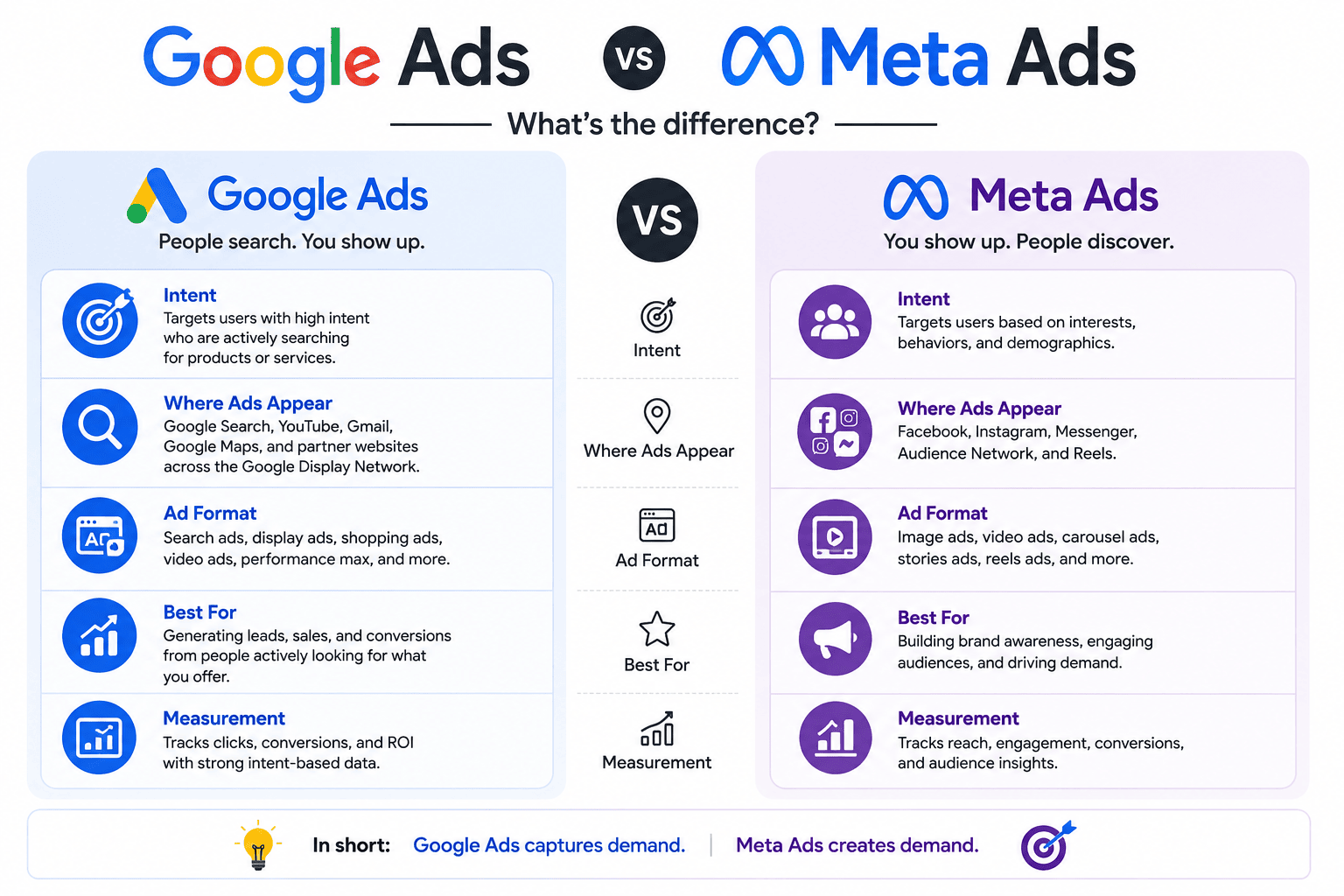
Google Ads and Meta Ads serve different business goals.
Google Ads is ideal for businesses focused on conversions because it targets users with high purchase intent who are actively searching for products or services.
Meta Ads excel at building brand awareness and reaching new audiences through interest-based and behavioral targeting.
The right platform depends on your business goals, budget, and where your customers are in the marketing funnel.
You have a budget, a product to sell, and a strong desire to grow your business.
You launch your first paid advertising campaign and immediately face a critical question: Google Ads or Meta Ads?
Both platforms can deliver impressive results.
Both can also drain your budget quickly if you choose the wrong strategy.
A poor decision could mean weeks of wasted ad spend with little to show for it.
This is a challenge businesses face every day.
The good news is that choosing the right platform follows a clear logic.
Once you understand how each platform works and what it does best, the decision becomes much easier.
Let’s explore the key differences between Google Ads and Meta Ads.
How Does Your Business Benefit from Google Ads and Meta Ads?
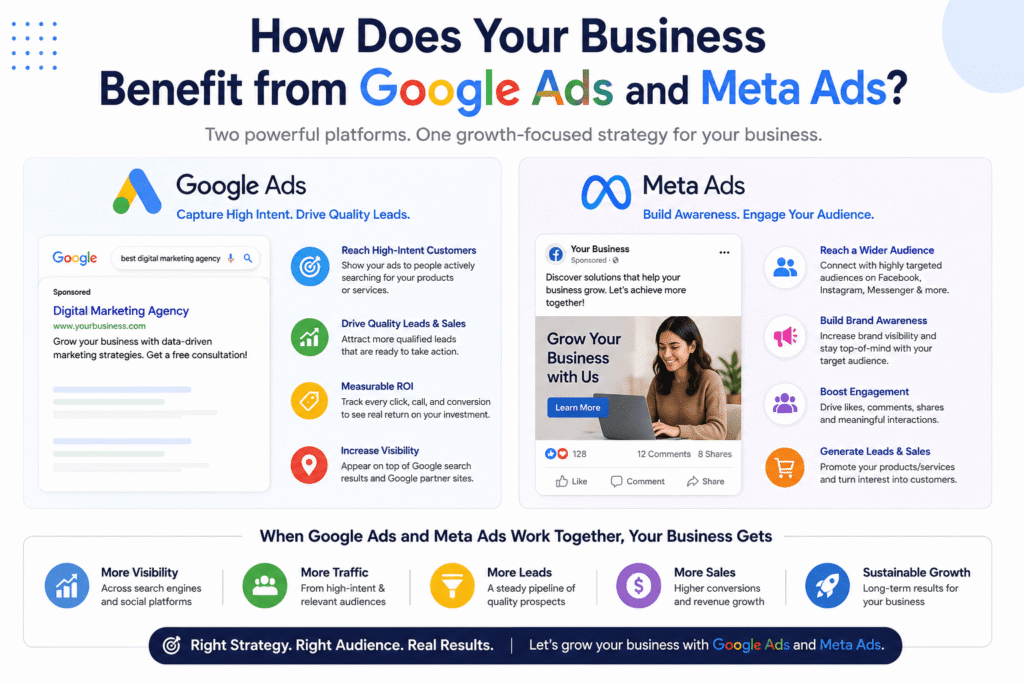
Google Ads (previously known as Google Ad Words) operates on a search intent model. Your ads appear when someone searches for a related query on Google Search or visits a site on Google’s Display Network.
You’re basically paying to be there when a potential customer is looking for what you can provide.Meta Ads (Facebook & Instagram) are built on an interest and behavior model.
Instead of waiting for users to search, Meta shows your ads to people based on their demographics, interests, and online activity.
You’re interrupting their scroll, but very specifically.Both platforms rely on auction-based bidding and are driven by increasingly sophisticated AI.
But their core mechanics yield very different results based on your business objectives.
What’s the Difference Between Google Ads and Meta Ads?
Here’s a side-by-side breakdown of how the two platforms stack up across the metrics that matter most to your business:
Google Advertising
Meta Ad Targeting
Keyword/search purpose
Demographics, interests & behaviors
Average CPC $2.96 (Search, Q1 2026) $0.78 (average 2026)
Average CVR 4.8 % ~2.0% (by industry)
Recommended for
High intent buyer
Discovery and awareness
Ad formats
Text, Display, Shopping, Video Image, Video, Carousel, Stories (Sources: Digital Applied 2026; Ryze AI 2026; First Page Sage 2026; AdAmigo AI 2026)
Google Ads costs more per click, but those clicks convert better. Meta ads are cheaper to run and have a bigger reach, but people aren’t always in a buying mindset when they see your ad.
When Does Google Ads Bring the Best Results for Your Business?
Google Ads works best for those customers who know they have a problem and are actively searching for a solution. Imagine a person searching for “emergency plumber near me” or “best CRM software for small business. That guy has intentions. They are ready to do the job.
Google Ads is usually most effective for businesses that:
Sell products or services with proven search demand
Jobs in the legal, finance, healthcare, or home services space.
Need instant conversions/leads
Have a well-defined product that solves a real problem
The trade off is cost. In competitive industries, like legal or insurance, CPCs can get much higher than the $2.96 average, sometimes $50 or more per click (Digital Applied, 2026). Those numbers add up quickly if you’re on a tight margin.
When Should Meta Ads Be Considered for Your Business?
Meta Ads are self-funding when your business creates demand, not just captures it. If your product is new, niche or visually driven, you can’t rely on someone to search for it – they don’t know it exists yet!
Meta ads are usually most effective for businesses that:
Sales of lifestyle, fashion, food, beauty or consumer goods
Looking to establish brand awareness in a specific demographic
Launching a new product and need to generate awareness
Develop a strong creative and visual identity
Meta Ads let you reach a ton of people for cheap.
The average CPC for Meta Ads in 2026 is only $0.78 (Ryze AI, 2026). The problem is that less purchase intent means you’ll often need a longer nurturing strategy — retargeting campaigns, email follow-ups, strong landing pages — to close the gap between interest and action.
How to Choose the Right Platform for Your Business Type?
Here’s a simple way to think about the decision:
If people are already looking for what you sell and you need conversions fast, go with Google Ads. This works great for local businesses, B2B services and e-commerce sites with high demand for their products.
If you want to build an audience, launch a new product, or build brand affinity over time, use Meta Ads. It’s a natural fit for D2C brands, content creators and businesses targeting niche lifestyle segments.
If your business has a multi-stage funnel, use both. Many successful businesses run Meta Ads at the top of the funnel to build awareness and retarget warm audiences lower down the funnel with Google Ads or Meta conversion campaigns.
How can your business have the best of both platforms?
Meta is expected to overtake Google for worldwide digital ad revenues by 2026 ($243.46 billion vs. $239.54 billion respectively) (eMarketer, 2026). That’s not a signal to bail on Google. That’s a sign of growth for both, and smart businesses are using both in concert.
A potential combined approach might be:
Brand Awareness – Use Meta video or image ads to get your brand in front of a cold audience
Retarget engaged users with more specific Meta or Google Display ads Consideration
Conversion – Get in front of high-intent searchers with Google Search campaigns
Retention – Re-target previous customers with new offers using Meta ads
It’s a full-funnel approach that maximizes your reach while keeping acquisition costs in check.
Choosing the best option for your business
There is no clear winner between Google Ads and Meta Ads. The right platform is theone that fits your business goals, your customers’ behavior, and where you are in your growth.
If people are already looking for what you have, go Google. If you want to build an audience and create demand, go Meta. And if you have the budget and the strategy for your business, running both platforms together is often the most powerful thing you can do.
Begin by understanding where your customers are and how they discover products like yours. Test, measure, then optimize from there. Paid advertising pays off for those who pay attention to the data!
Frequently Asked Questions
Google Ads or Meta Ads: What’s Better for a Small Business on a Budget?
Meta Ads are usually the more cost effective starting point for small businesses with a tight budget. Meta Ads offers a larger reach for a lower cost, with an average CPC of $0.78 in 2026 (Ryze AI, 2026). But if your business operates in a high intent niche with clear search demand, even a modest Google Ads budget can yield strong ROI. Test both with small amounts before you commit.
Which platform works better for e-commerce businesses in terms of conversion?
The Google Ads average conversion rate is higher at 4.8% (First Page Sage, 2026) than Meta Ads which is around 2% across industries (AdAmigo AI, 2026). Google Ads generally has a better conversion rate for e-commerce businesses with established products and known search demand. Meta Ads work well for new product launches or for visually driven brands looking for awareness first.
Yes, a business can run Google Ads and Meta Ads at the same time.
Yes, and many companies find it easier to run both platforms together than to run one without the other. The common approach is to use Meta Ads to create awareness at the top of the funnel, and Google Ads to target high-intent searchers who are ready to convert. The trick is to align each platform with a specific stage of your customer journey.
What’s a good budget for Google Ads or Meta Ads?
There is no single answer for all, as budgets differ greatly depending on industry, goal and competition. A good place to start is budgeting enough money to get meaningful data, usually $500-$1,000 per month per platform at a minimum. Then scale what works for you from there. When working in very competitive industries like legal or finance, Google Ads costs can be much higher, so factor in your margin per customer when setting your targets.
What’s the best platform for B2B?
Google Ads typically works better for B2B companies because decision-makers are actively looking for solutions – search intent is a good signal to use . Don’t forget about LinkedIn Ads for B2B. Meta Ads can be a good addition to a B2B strategy for brand awareness, but are less often the primary source of qualified B2B leads.