



Confused about how SEO really works? You are not alone. Search engine optimization (SEO) is the process of optimizing your website to rank higher on Google when people search. In this guide, you will learn what SEO is, the four types of SEO you need to know, how to rank higher, and how SEO relates to two more recent concepts, Answer Engine Optimization (AEO) and Generative Engine Optimization (GEO). By the end you will understand how to make your content visible to search engines and AI tools.
“Key Takeaways
SEO gets your website found in search results. And 68% of all online experiences begin with a search engine (BrightEdge).
There are four main types of SEO: on-page, off-page, technical and local SEO — each with a different role.
Ranking higher can be helped by keyword research, quality content, link building, and technical fixes.
AEO (Answer Engine Optimization) optimizes your content to be the direct answer in AI summaries and featured snippets.
GEO (Generative Engine Optimization) helps AI tools such as ChatGPT and Google AI Overviews to cite your content.
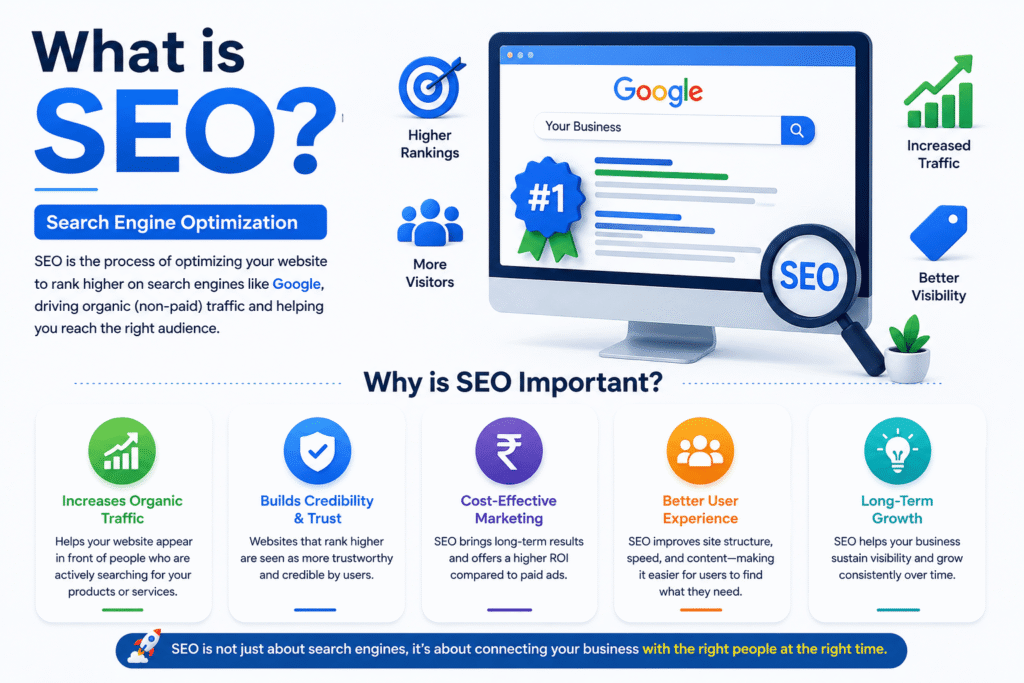
What is SEO and Why is it Important?
SEO is the process of optimizing your website so that it can rank higher on search engine results. SEO gets your page in front of people searching for a product, service or answer – hopefully near the top.
Why is this so important? Traffic is driven by search. BrightEdge says that about 68% of online experiences start with a search engine. Most of your potential audience starts there as Google owns over 90% of the global search market (StatCounter).
The reward is real. SEO leads close at a rate of 14.6% while outbound leads close at a mere 1.7%. Organic search generates approximately 53% of all website traffic. That means free, long-term visibility – without paying per click – for students, freelancers and small business owners.
96.55% of all pages get zero search traffic from Google. Good SEO is the difference between pages people find and pages no one ever sees.
What are the Types of SEO?
SEO is not one thing. It breaks down into four main types, each supporting a different part of your strategy. You don’t have to learn them all at once, learn the basics and then build from there.
On-Page SEO Optimization
On-page SEO is everything that you optimize on your actual web page. This includes your titles, headings, content, images and keywords.
The goal is simple: make sure your readers and search engines understand the content of your page. You do this by using clear titles, well placed headings, useful content and naturally placed keywords. So even though it’s a small choice on the page, those small choices add up and pages with a keyword in the URL see a 45% higher click-through rate.
Off-site SEO
Off page SEO is the work you do outside your website to build trust and authority. The biggest piece here are backlinks links from other websites pointing to yours.
Backlinks are like votes of confidence. The more quality sites linking to you, the more trustworthy you seem to Google. In fact, the #1 search result has 3.8x more backlinks than the results in positions 2-10 (AIOSEO). Brand mentions, guest posts and social signals are also part of off-page SEO.
Technical SEO
Technical SEO is all about ensuring that search engines can crawl, read, and index your site with no issues. It is important, but it operates behind the scenes.
The main areas are site speed, mobile-friendliness, secure connections (HTTPS), and clean site structure. The data reveals the frequency with which this is disregarded — just 33% of websites meet Google’s Core Web Vitals threshold, and 72.3% of sites have slow pages (Ahrefs). Tackling these problems gives you a competitive edge that others don’t have.
Search engine optimization local
Local SEO puts your business in front of people searching for “services near me.” If you run a shop, clinic or local service, this type is a must.
The chance is enormous. About 46% of all Google searches have local intent and 76% of people who search for something nearby visit a business within a day (Google). This is where your Google Business Profile has the most impact – it makes up 32% of the local pack ranking factors (Whitespark). And 58% of companies still don’t optimize for local search (ReviewTrackers), meaning there’s opportunity for those who do.
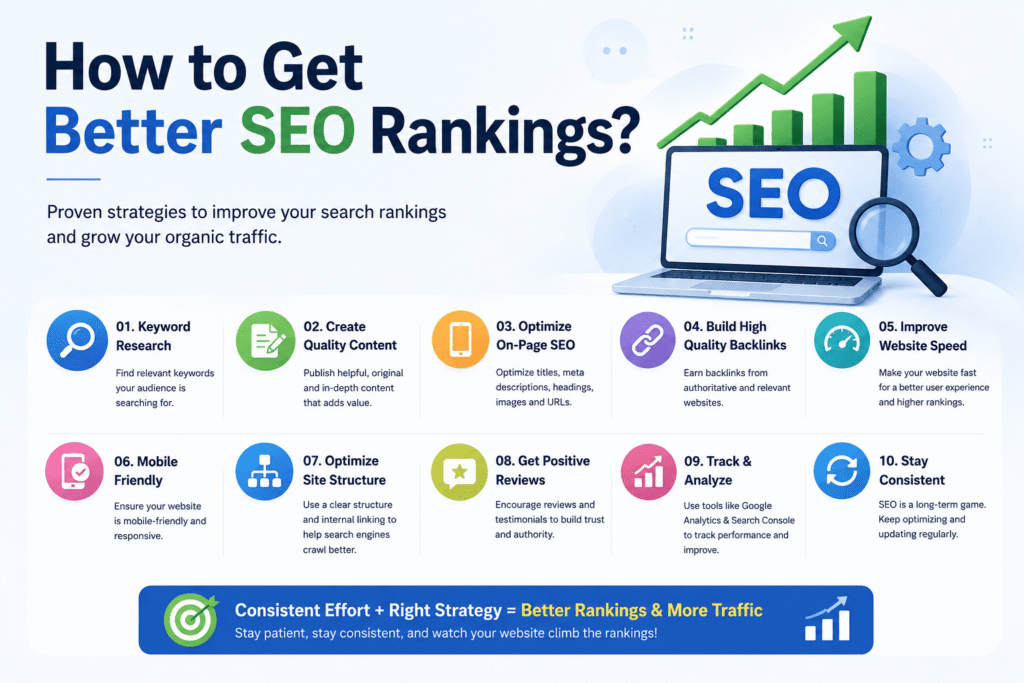
How to get better SEO rankings?
Ranking higher is all about four core actions. Google, which uses over 200 ranking factors (AIOSEO), still considers high-quality content, backlinks, and search intent as the top three ranking factors in 2026. Follow these steps in order and you’ll have a solid foundation.
Step 1: Perform Keyword Research
Keyword research is finding out the words and phrases your audience types into Google. Start here because everything that comes after depends on the choice of the right keywords.
Target long-tail keywords – longer, more specific phrases that have less competition. They’re easier to rank for and better align with real user intent. This is important because 94.74% of keywords get 10 monthly searches or less (Ahrefs) . Hence, targeting niche keywords is often a better idea than targeting high-volume keywords. Free tools like Google Keyword Planner and Google Trends are a great way to get some practice.
Step 2: Produce quality content
Good content is the heart of SEO. Your page should answer the searcher’s question completely and clearly.
You’ll find lots of helpful, original and easy to read content here. Match the search intent Serve people exactly what they came for. Longer, in-depth content tends to do well, too: Articles over 3,000 words get 3x more traffic and 3.5x more backlinks than average-length posts (AIOSEO). But don’t fatten up your writing. Depth must always serve the reader.
Step 3: Backlink creation
Backlinks are a sign of authority and help you climb the rankings. quality beats quantity, every time.
Here are some practical ways to get backlinks:
Make useful content that people will naturally link to.
Guest posts on relevant blogs in your niche.
Add your business to trusted directories & resource pages.
Connect with other creators and businesses.
95% of pages have no backlinks (AIOSEO) A few good links can make a big difference.
Step 4: Fix technical problems
Technical optimization ensures your hard work will actually be seen. Google ranks you better and visitors are happy with a fast clean mobile friendly site.
- Check these technical basics:
Speed: Get pages to load fast.
Mobile: Make sure your site is mobile-friendly – mobile makes up roughly 60% of all web traffic (AIOSEO).
Security: Use HTTPS
Structure: Clear headings, fix broken links and have one H1 tag per page.
Master these four steps and you’ll have everything you need to compete in search. Now, let’s look at where search is headed next.
What is the link between SEO and AEO?
Answer Engine Optimization (AEO) is the process of optimizing your content to be the direct answer we see — in featured snippets, voice search results, and AI summaries. It’s an outright extension of your SEO foundation.
Search behavior is changing. In the US, around 60% of searches now finish without a click (in 2022, it was 26%) as users get their answers on the results page. To be successful here, your content has to be able to answer questions clearly and concisely.
Here’s how to make the most of AEO:
Answer questions directly in the first sentence or two of a section.
Use clear headings that pose real questions people ask.
Keep your answers short. Most AI Overview answers are less than 328 words.
Add FAQ sections to capture common follow-up questions
The award pays. Answer engines deliver 27% higher click-through rates on cited sources than traditional search placements. AEO is not an alternative to SEO, it’s an addition.
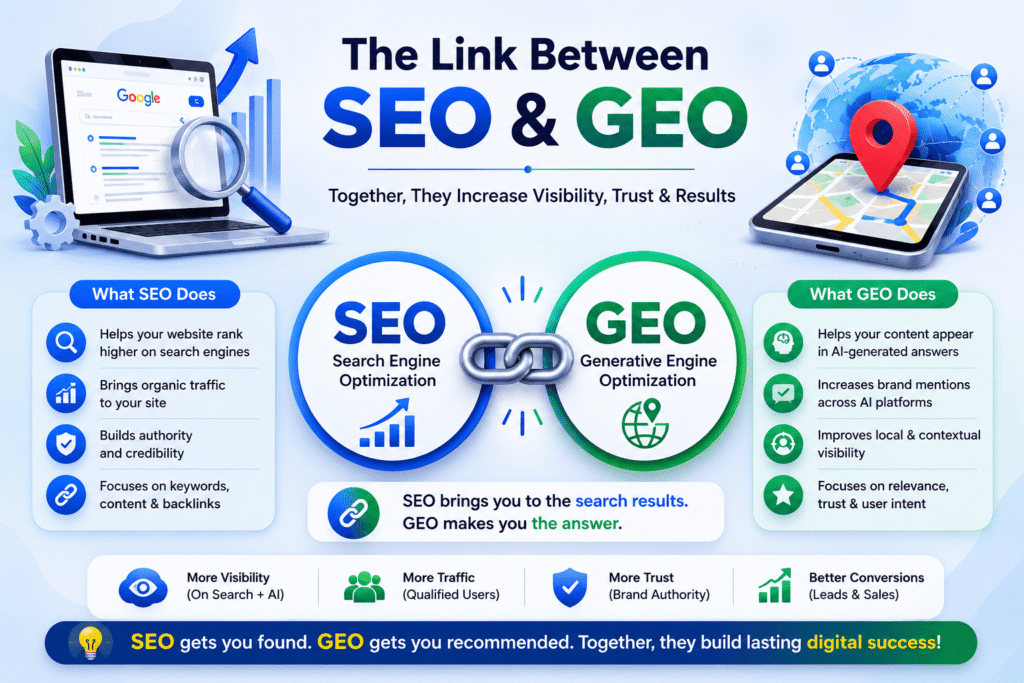
What is the link between SEO and GEO?
GEO stands for Generative Engine Optimization and means optimizing your content for AI tools such as ChatGPT, Google AI Overviews, Perplexity to cite your content in their generated answers. With AI search exploding, visibility is becoming more and more about GEO.
The change is coming quickly. AI-powered search traffic is said to have increased by 527% (AIOSEO), with nearly 78% of all AI referral traffic globally coming from a single source, ChatGPT (SE Ranking). AI tools draw from sources they trust, so your job is to be one of those sources.
Here’s how to optimize for GEO:
Write clear, self contained facts that AI can easily understand and quote.
Keep content fresh — Content that includes AI citations is, on average, 25.7% fresher than the standard top-ranking pages (Ahrefs).
Add structured data (schema markup) to help AI read your content. Keep in mind that 31.2% of sites still aren’t using it, so it’s an easy win.
Build authority with expertise and quality, since AI favors trusted sources.
One big caveat: old-school search isn’t going anywhere. Google still drives 345X more traffic than combined traffic from Perplexity, Gemini, and Chatbot (Ahrefs). The smart move is all three — SEO, AEO and GEO.
Your next move with SEO
SEO, AEO and GEO are not three different fights. They are layers of one strategy. Strong SEO builds the foundation, AEO puts you in the answer position and GEO keeps you in sight as AI changes search.
Begin small. Pick one SEO, learn how to do keyword research, and create content that actually helps your audience. Build from there, step by step.
If you want hands-on experience rather than just theory, then the fastest way to build confidence is to learn SEO through real projects. Digital Vishnu Academy provides job-ready skills and lets you run real campaigns with practical, mentor-led SEO training in Coimbatore. Embark on your digital marketing journey now.
Frequently asked questions (FAQ)
Simple Words: What Is SEO?
SEO means Search Engine Optimization. It’s the act of optimizing your website to rank higher in search engines like Google. The higher you rank the more people can find your site through free, organic search.
SEO results: how long does it take?
SEO usually takes 3-6 months to begin to see meaningful results, and often longer for competitive topics. That’s normal – 72.9% of pages in Google’s top 10 are over 3 years old (Ahrefs). SEO is a long term investment, not a quick fix.
What is the difference between SEO, AEO and GEO?
SEO is the process of optimizing your content so that it ranks in search results. AEO optimizes it for direct answer in snippets and AI summaries. GEO makes it optimal for citation by generative AI tools, such as ChatGPT. All three of these work together to boost your visibility.
Is learning coding necessary for SEO?
Nope, you don’t need to be a coder to do SEO. Most on-page, off-page and local SEO work doesn’t require any code. A little technical SEO is needed, but with tools and step-by-step instructions, it’s easy for beginners.
Is SEO still worth it with the rise of AI search?
Yes, SEO is still very much worth. Google drives 345x more traffic than all major AI tools combined (Ahrefs). Organic search is about 53% of website traffic. AI hasn’t replaced SEO, it has just added new layers like AEO and GEO.



World Media News